All posts by michaelbrummett

Lesson from Finances: Part I- Money, Money, Money

So I’ve done a fair share of reading over the past three years on financial matters- economics, personal finance, investing and the like. And though I’m hoping such time and energy investment will pan out into some successful financial investments, I’m already beginning to see some corollary benefits in other areas of life- particularly our relationships to God and to each other.

So I hope to lay out a ‘plan’ of action that I’ve somewhat intuitively begun to follow, but hope to step up into a more disciplined and intentional endeavor. But first, the background knowledge.

Most of this basic knowledge I picked up from the book Rich Dad, Poor Dad by Robert Kiyosaki. I HIGHLY recommend it for the content (but stylistically, Kiyosaki is not a very good writer). In short, he essentially had ‘two Dads’- one who was his real, biological father (the ‘Poor Dad’) and his best friend’s father (who became phenomenally wealthy). In having these two powerful influences he was able to clearly see differences in thoughts and actions that are the true distinctions between the rich and the poor (that ultimately lead to the obvious distinctions of net worth.)

The biggest misconception is that wealth is a product of one’s income- “If only I could get a higher paying job, I could be rich!” And while that couldn’t hurt, income is not really the issue. Consider the “richest” man in the world- currently tagged as Warren Buffett. His annual income, from his job, is only $100,000 a year. And yet his net worth is far in excess than execs who ‘earn’ 10 times that amount.

But notice I qualified his income as being ‘from his job’ (his job, by the way, is Chairman and CEO of Berkshire-Hathaway). I’m sure he has other income- but it is income that comes from holding certain assets like stocks and such (although, even with that, his largest holding is in Berkshire-Hathaway stock, which he probably doesn’t actually receive money from as Berkshire doesn’t pay out dividends). You see, the secret to wealth is not in the income, but in the assets that one owns.

Rich people, essentially, operate like businesses. When you evaluate businesses you look at their financial statements which include an income statement (which includes expenses they pay) and a balance sheet that lists the company’s assets and liabilities.

Robert Kiyosaki breaks it down like this:

The Poor and Middle Class primarily have financial statements that look like this:

Money comes in as income from their job(s) and then gets filtered through a lengthy list of liabilities (auto loans, mortgages, school loans, credit card debt, etc.) and so gets sent out of their possessions through all the expenses that these liabilities generate.

Rich people, however, have financial statements that go more like this:

As much as their income as possible goes into purchasing assets- in particular for our case, earning assets. And this is an important distinction. Some things are considered assets because they are ‘worth’ a certain amount. That’s why many people include their cars and boats and homes in their asset column. However, to utilize those assets in a financial sense you would have to sell them, which then means you no longer have that asset. Plus, you can rarely sell them for the amount that you can list them in your ‘Asset’ column. Another, very unfortunate plus, is that the ownership of these ‘assets’ often comes with a substantial addition to the liabilities side: car payments and mortgages. Which is why middle-class folks have most of their money filtering through the liabilities side and out through the monthly expenses even though they may be ‘wealthy’ enough to own the big screen TV’s, Bimmers, Hummers, and large homes in the ‘right’ neighborhood.

True wealth (and healthy businesses) results from assets that earn income- adding to what the ‘job’ brings in rather than siphoning it all out.

Some debt may be unavoidable, and may even be advantageous- IF you receive more than you pay out. For example the return you get on a rental property- in terms of actual profit above the monthly debt payments, may make a mortgage more justifiable. As the income stream widens, the debt becomes less and less significant.

That’s the secret to wealth in a nutshell. But always the generalist- I like principles that have more than one application- and life isn’t all about money…

…to be continued.
Cultivating Boredom – Part II

Given my fascination with new connections, new thoughts, new conceptualizations I noticed myself getting almost giddy at the thought that something as boring as boredom could actually be a tool to gaining new insights. Before I go on with my own analysis, however, I want to continue a quote from Robert Irwin that I started in Part I, where he was talking about taking several catnaps while engaging in the rather boring activity of sitting and looking at rather minimal paintings for several hours/days at a time. He continues by saying:

“Boredom is a very good tool. Because whenever you play creative games, what you normally do is you bring to the situation all your aspirations, all your assumptions, all your ambitions- all your stuff. And then you pile it up on your painting, reading into the painting all the things you want it to be. I’m sure it’s the same with writing; you load it up with all your illusions about what it is. Boredom’s a great way to break that. You do the same thing over and over and over again, until you’re bored stiff with it. Then all your illusions, aspirations, everything just drains off. And now what you see is what you get. Nothing more. A is A and B is B. A is not plus plus plus all these other things. It’s just A.”

Now, Robert Irwin was after a kind of ultimate objectivity. He was fascinated with pure perception and was troubled with, for example, abstract paintings that people could ‘see’ things in- much the same way that we look at clouds and see shapes that resemble bunnies, or ice cream cones, or whatever. He wanted a pure experience prompted from some thing (the artwork) that was nothing else but what it was.

However, I’ve always felt that the most valuable aspect of art was as an aid to self-reflection. So I also want to point out a side benefit to the process Robert Irwin described above. In seeing ‘A’ for ‘A’ and ‘B’ for ‘B’, I think we’ll also get a clearer picture of all of our ‘stuff’ that previously got in the way. To couch it in my earlier terminology- we’ll be able to see more clearly our Platforms that we’re ‘standing’ on. But we’ll see them not as the veritable truth that we previously hung our hat on but as something that distorted our perceptions- something that could actually be wrong… or even… expendable. Our perspective shifts a little because something as inane as boredom resensitizes us to see truth more clearly- a truth that doesn’t rely on our previous assumptions and aspirations.

So, to all my fellow ‘Dwellers’- I urge you to actively cultivate boredom. When you’re bored with the passage, read it again. If nothing new is coming to you DO NOT make something up- that just loads more ‘stuff’ onto it that obscures insights into truth. Just sit with it, accept ‘nothingness’ if nothing is coming to you, and allow boredom the time it needs to peel the subjective from the objective.

And for any other situation you may face, especially one of uncertainty, unless it is absolutely necessary to make a decision regarding something, you might try just letting the uncertainty float for awhile, until you’re bored stiff with looking at the same options, the same data, the same ‘unclarity’. I’m positive that boredom will prove fruitful, that you will see A and B more clearly, that you will see yourself more clearly, and that you’ll ultimately be better off for it.

To close, ponder one more quote from Zen and the Art of Motorcycle Maintenance:
“He’s interested. ‘What’s it going to be like?’

But there’s a slight ego gleam in his eyes as he asks this and the answer as a result comes out masked.”

Experience Forgiveness

I want to make you feel bad. I know, that’s probably not the ‘right’ thing to say but to a large extent it’s true. I would love for you to feel absolutely horrible about yourself. We’re all pretty adept at denying, so I’m searching for ways to throw your sin up in your face so that there is no room for denial. So you are faced with the fact that you’re a wretched person- to the point where you don’t know how to deal with it or what you’re going to do with yourself.

Sound a little harsh? Do I sound vindictive? Judgmental? Probably- which is why I haven’t pursued this as a course of action… yet. But the desire is still there. It’s just a question of getting across my motives.

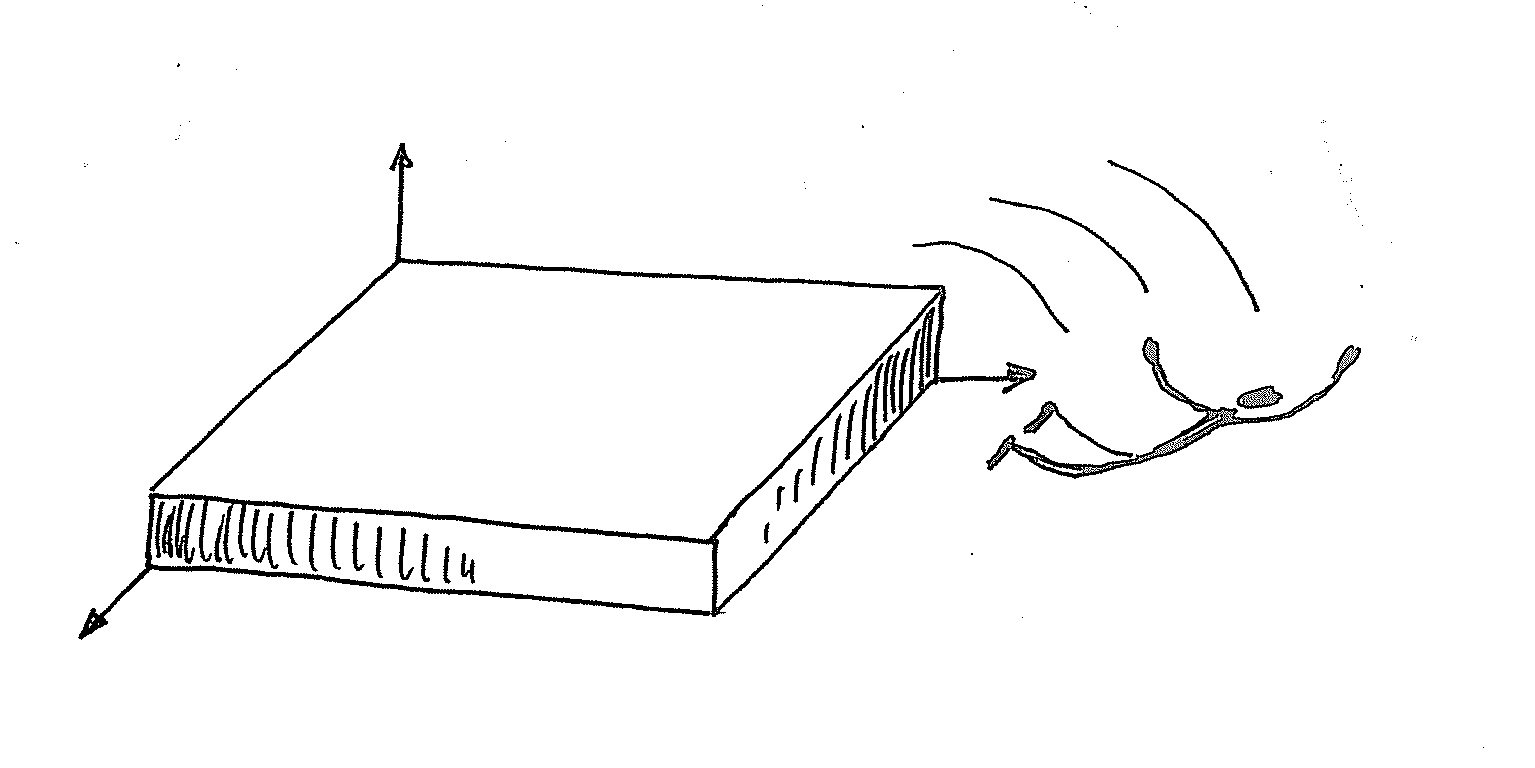
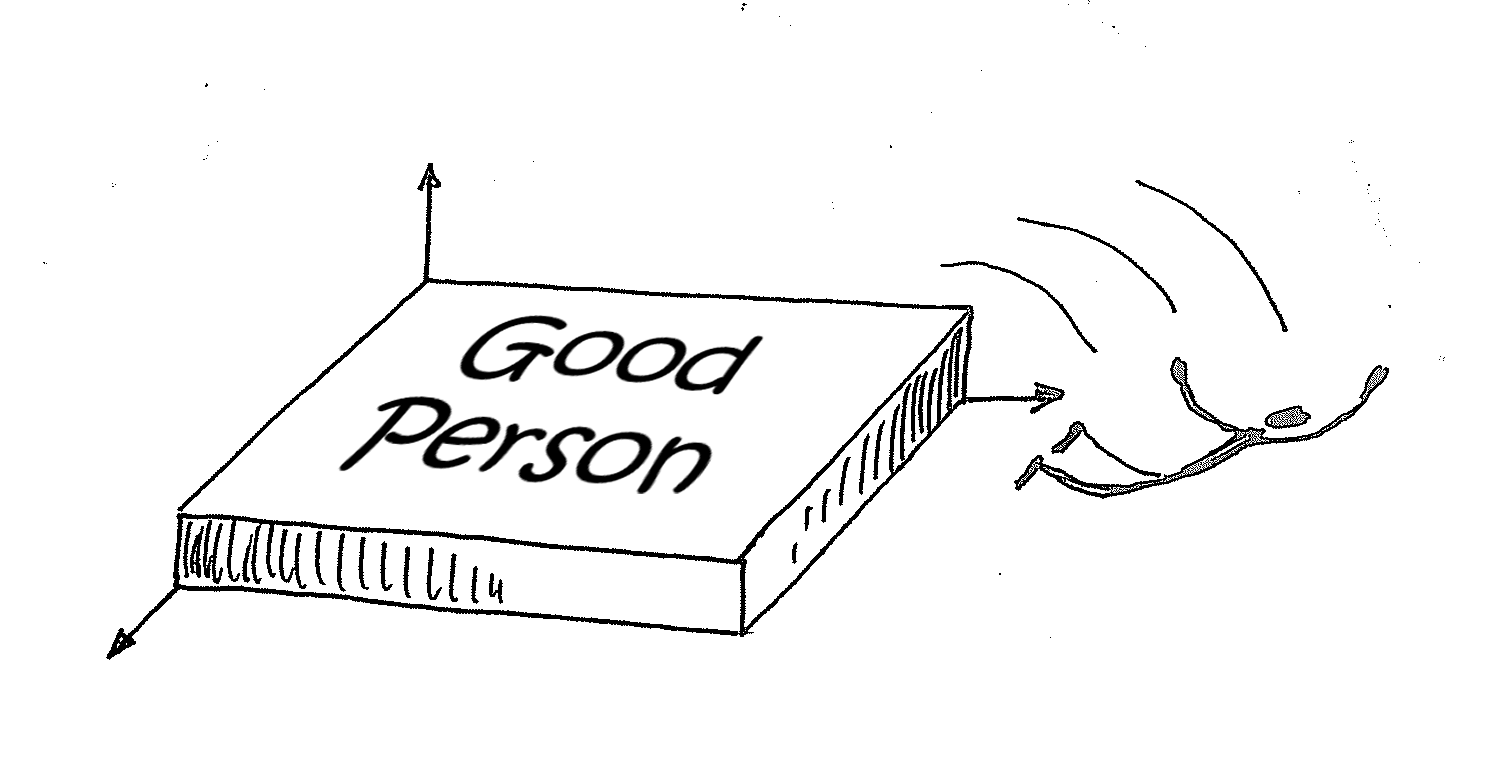
You see, I’ve had a few moments like that- where my foundation was shattered. I couldn’t believe I had done what I did- yet there was no way I could deny it. When my ‘platform’ consisted a great deal of me being a ‘good person’- I mean, I grew up in the church, I was a leader in my youth group, I had never done drugs, never gotten drunk, etc., etc.- then when I was faced with the undeniable fact that I had caused someone I cared deeply for a tremendous amount of pain, I could not justify myself as a ‘good person.’ I had kicked myself off the Good Person Platform. And the question that haunted me was: If I’m not a Good Person, what am I?

The answer was: I’m forgiven.

Oh sure, intellectually we know that we are sinners and that we’re forgiven. But try pointing out a specific sin to someone and watch the justifications, denials, and counter-accusations fly! It’s like a fireworks show! (And from a social sciences perspective it is a fascinating show to watch.) Because existing side by side with the ‘confession’ of being a ‘sinner’ is the conviction that “I’m a ‘Good Person’.” I’m Ok. I can point out any number of good things I do and the (generally longer) list of bad things I don’t do. I can point out all those character traits in other people that I don’t share.

And so we build up our platform. Our Good Person Platform. And it’s so well crafted and sturdily constructed. And it becomes like an office, with a large, wooden desk and a plush leather chair. There are plants and a bookshelf with a fine collection of books. There are pictures of our loved ones on the desk. Everything is nice and neat and orderly. And on the wall, in a cheap frame, is a piece of paper saying “I’m a sinner and I was forgiven,” displayed like a certificate showing that you ‘graduated’ from a two-day class on how to use Microsoft Excel. There it is. There is our ‘confession.’

The difference between that kind of confession, and a brutally honest facing-of-the-facts is like the difference between experiencing a beautiful sunset by yourself and someone telling you the colors they saw in a sunset- the experience just doesn’t translate.

The experience I want you to have is the experience of being forgiven. But you can’t have that experience until you really feel you have something to be forgiven- and for a brief while, that experience is horrible.

So I want you to feel horrible. I want you to see yourself (and your sin) clearly for the first time, so that you are utterly speechless, and utterly terrified. And I want you to close your eyes as the tears well up and you’re flooded with the realization that all your justifications fall short; terrified with the thought of what others might think of you. Wondering what all this means, feeling the free-fall sensation of not being who you thought you were. Then I want you to open your eyes… and see that I’m still there with you.

Experience forgiveness.

Cultivating Boredom – Part I

Note: For this two-part blog I want to first propose some instructions for reading. First, find some rather mindless, repetitive, and/or boring task. Some examples may be mowing the lawn, doing the dishes, folding clothes-while NOT watching TV, or… painting a gazillion dots on dominoes that have been painted on canvas (I can supply you with ample opportunity for this last item, if you’re interested.). Read over the quotes on this first part right before performing that task, using the freed up mental space to reflect on the quotes. Then, read my comments on Part II (to be posted tomorrow). Finally, apply these thoughts by reviewing the ‘facts’ of any situation you feel needs to be worked through before engaging in any of the tasks mentioned above, again using the available mental activity to reflect on your situation. Repeat that last step as necessary until something materializes.

I’m borderline obsessive on connections. What I mean is, I tend to read a ton of (often) different material, and the things I live for are those moments when some idea presented in one book, seems to sound an awful lot like an idea put forth in another book, which, in turn, corresponds to something going on in my life. The resultant web of connections brings new understanding, greater insight, and (hopefully) an increase in the effectiveness in my daily actions/interactions. There have been several such connections made in the past few months that have set me on new levels of hope and faith so I thought I’d share a specific example. So for Part I we’ll just look at the raw data. Consider the following quotes/situations:

Book I: Zen and the Art of Motorcycle Maintenance by Robert Pirsig.
“She seems so depressed sometimes by the monotony and boredom of her city life, I thought maybe in this endless grass and wind she would see a thing that sometimes comes when monotony and boredom are accepted.”

“The engine consists of a housing containing a power train, a fuel-air system, an ignition system, a feedback system and a lubrication system.
The power train consists of cylinders, pistons, connecting rods, a crankshaft and a flywheel.
The fuel-air system components, which are part of the engine, consist of a gas tank and filter, an air cleaner, a carburetor, valves, and exhaust pipes.
The ignition system consists of an alternator, a rectifier, a battery, a high voltage coil and spark plugs.
The feedback system consists of a cam chain, a camshaft, tappets and a distributor.
The lubrication system consists of…
The first thing to be observed about this description is so obvious you have to hold it down or it will drown out every other observation. This is: it’s just duller than ditchwater. Yah-da, yah-da, yah-da, yah-da, yah, carburetor, gear ratio, compression, yah-da-yah, pistons, plugs, intake, yah-da-yah, on and on and on… Dull, awkward and ugly…But if you can hold down that most obvious observation, some other things can be noticed that do not at first appear.”

“When cleaning I do it the way people go to church- not so much to discover anything new, although I’m alert for new things, but mainly to reacquaint myself with the familiar. It’s nice sometimes to go over familiar paths.
Zen has something to say about boredom. Its main practice of “just sitting” has got to be the world’s most boring activity…Yet in the center of all this boredom is the very thing Zen Buddhism seeks to teach. What is it? What is it at the very center of boredom that you’re not seeing?”

Book II: Seeing is Forgetting the Name of the Thing One Sees: A Life of Contemporary Artist Robert Irwin by Lawrence Weschler.
“I started spending the time just sitting there looking. I would look for about fifteen minutes and just nod off, go to sleep. I’d wake up after about five minutes, and I’d concentrate and look,… and I’d nock off again. It was a strange period. I’d go through days on end during which I’d be taking these little half-hour, fifteen-, twenty-minute catnaps about every half hour- I mean, all day long… It was a pretty hilarious sort of activity… I put myself in that disciplined position, and one of the tools I used was boredom.”

Personal Life Situation:
Dwelling in the Word. There may be a couple of you who read this that may not be familiar with this term. There are several churches in the area (and throughout the U.S./world(?)) that are going through a process called Partnership for Missional Church through an organization called Church Innovations. One of the core practices in this process (a process that lasts about 3 years) is called ‘Dwelling in the Word.’ We take a passage, and every time we meet together as a church, we spend time in that one passage for an entire year. It’s a practice that will often make you…bored with the particular passage.

Hhhhmmmmmmm…….

Jackson Pollock


Once I started to ‘get’ abstract art, I became a fan of Jackson Pollock- even though I probably couldn’t come close to explaining why at the time. I just thought they looked cool. And while that is still part of it, I think I can come closer to explaining something that might be of interest or value. Incidentally, Jackson Pollock currently holds the record for the most amount of money ever paid for a painting. Entertainment mogul David Geffen sold a Pollock painting for about $148 Million to a collector in Mexico (I think). Not a bad haul.

Ok- so what’s the big deal about this guy who slings paint around much like a 2 or 3 year old? (And, subsequently, why can’t you sell your child’s ‘masterpieces’ for $148M?) Well, it’s kind of like something funny that comes up in the course of a situation or conversation that is only funny to the participants, in other words, “you had to be there.” You kind of have to really ‘be there’ to get his works. And here’s some of what it means to ‘be there’ with regard to art: it’s not about what it is but what it is doing.

So let’s take a Still Life, for example, like a picture of flowers. Those who ‘don’t understand art’ see it for what it (apparently) is- a bunch of flowers. Artists will look at the same picture and see how the flowers are placed within the picture and what the placement does in terms of movement or balance. And/or they’ll look at the colors and see what they are doing– harmonizing with each other? Clashing with each other? Describing the colors we see? Evoking emotions?

And here’s another crucial difference- artist’s see things that way when they are looking at ‘ordinary’ objects- not just paintings of those objects. So let’s follow that. An artist looks at an arrangement of flowers and it ‘affects’ him or her. So the artist illustrates the flowers in an attempt to record those feelings and convey that to someone else. The problem is- what if the person viewing the painting doesn’t have the same emotional response because they’re not into flowers (they like sunsets)? Then the artist has failed to communicate his or her experience. So, instead of depicting the source of his or her emotional response- the flowers- the artist attempts to depict in some way the experience itself. Then the viewer can take that experience and connect with it- “oh yeah, I once saw a sunset that made me feel the same way!” And it’s when you try to depict an experience – which in itself is abstract- that you start getting abstract art.

In Jackson Pollock’s case, we have a troubled individual- an alcoholic (though I’m always quick to point out his best paintings came from the 2 or 3 years when he was not drinking)- living in troubled times- think of World War II and the Atom Bomb. Often troubled feelings like this are buried deep in people’s subconscious- we react to someone doing something relatively insignificant, but it’s not really what they did that made us so mad but the fact that it happened at a time when so much other stuff was troubling us, even though we weren’t actually conscious of it. So with that in mind, consider this quote from the artist himself:

“When I am in a painting, I’m not aware of what I’m doing. It is only after a sort of ‘get acquainted’ period that I see what I have been about. I have no fears about making changes, destroying the image, etc, because the painting has a life of its own. I try to let it come through. It is only when I lose contact with the painting that the result is a mess. Otherwise there is pure harmony, an easy give and take, and the painting comes out well.”

There was a group of artists originating around the 1920’s called the Surrealists who would use a technique called ‘automatic drawing’ to bring up images buried in their subconscious. In essence it could be like doodling- only they felt that if you weren’t controlling the line to depict something, the shapes that would naturally flow through your arm and hand would be dictated by your subconscious thoughts and feelings. Jackson Pollock would begin his paintings that way and then study them- often for weeks or months at a time- so ‘see what I have been about.’ As recognition of those thoughts and feelings surfaced he would then make revisions and fine tune the lines and colors until the resulting painting matched his impressions. So the ‘beauty’ comes through in the harmony of the feelings and the means of depicting those feelings- not through illustrations, but through psychological associations with lines, shapes, colors, etc.

When this really hit home for me was when my lovely wife took me to New York to see his retrospective exhibition as a Christmas present. Being able to see almost all of his works, laid out chronologically, I was able to witness firsthand the fact that his splatter paintings actually got better. How can one splatter be ‘better’ than another? There was a greater degree of harmony once you became attuned to what the paint and the lines and the colors were doing rather than just looking at them as what they were- ‘messy splatters of paint that my three year old could do.’ As Jackson Pollock became more attuned to this in the process of painting he was able to depict his feelings with greater clarity.

I’ll admit- I’ve seen my kids make some cool things. But they are often just small sections of a larger ‘painting’ that on the whole is just a messy mess of paint or crayons or marker. The child lacks the intellectual skills to recognize a good thing when they see it (in the art world we call those ‘happy accidents’) and bring the rest of the disorderly picture in harmony with the good parts- the parts that strike a chord between color, shape, and line and the emotions that they convey. Jackson Pollock had that capacity, and he developed it further when he was not clouded by his addictions. And the results, once you’re ‘there’ in the ‘conversation,’ are breathtaking even far beyond what I’ve intimated here. (But we’ll just chew this elephant one bite at a time, shall we?)

And if you don’t believe me, consider this: every single time I had an art student attempt to do a ‘splatter’ painting like Jackson Pollock, they were astounded at how difficult it was and realized how horrible theirs looked in comparison with his. (Maybe you should try it sometime.)

On Human Interaction- part III

I hesitate to write this post. It’s taken me awhile to write partially due to lack of time (I mean, it takes me longer to write them than it takes you to read them!) but also because when I stated my ‘main idea’ to myself, it seemed horribly self-evident. It sounded like many other ideas I have heard. On the surface it didn’t seem to be anything new. With regards to it’s self-evidence, the artist Robert Irwin has something to say: “If all of this seems a bit familiar, it should. This process…something we already do at every moment in simply coming to know the nature of our presence, and we almost always do so without giving the wonder of it a second thought… this ‘oversight’ speaks not of its insignificance; on the contrary, it speaks of its extraordinary sophistication.” Sometimes, when things are so familiar, we don’t give them a second thought- but it can be striking when we finally realize how sneaky they have been, sneaking under the radar and affecting everything we do, say, or think without us even being aware of it.

So here it goes: It’s all about relationship.

Actually, it’s all about GOD, and that is borne out solely through relationship. But we’re going to start with it being all about relationship and try to carry it to its logical end, and then we’ll see that it’s all about GOD.

I feel I’ve heard this before. So why do I get that ‘tingly’ sensation when I start to picture this in my mind? After much thinking and reading, I think I’m beginning to put my finger on it. Remember when I said that often ideas themselves don’t seem like a big deal, but rather it’s their implications? I get a shiver up my spine because now when I say ‘it’s all about relationship’ I have a whole new set of implications that comes to mind. With regard to the above statement- that it doesn’t seem like anything new- it’s true… as far as surface appearances go.

But you have to watch out with regard to surface appearances. I’ve long considered the conundrum posed by surface appearances. I think of people who are “rebels.” In my own upbringing in the Church of Christ, I grew up in the context of my parents becoming progressively more ‘liberal’ than the generation before them. There were often arguments made by the ‘old guard’ that certain new behaviors in church ‘looked like’ what the Baptists, or the Evangelicals, or more charismatic movements did. So it got me thinking: what happens, or how do you deal with, the possibility that after spiritual growth and seeking and studying you arrive at the conclusion that your behavior should look like the very behaviors you’ve been fighting against? I think some people would have a serious problem with that. Some people are hooked on the externals. So even though there may be vast differences in theology and understanding, the resulting behaviors may appear remarkably similar and thus presumed to be from the same motives.

But again, there’s a lesson for this from Einstein. One of the ‘dangerous implications’ of E=mc2 is that everything we see around us is closer to a surface appearance than it is to cold, hard, unyielding physical matter. Mass changes- which doesn’t seem to jive with our day to day experience. For example, when you are exercising, technically you are heavier because there is more energy being utilized and energy has mass, or weight*. (Now if that isn’t a reason not to exercise, I don’t know what is! ha ha.) But the ‘weight’ gained is so infinitesimally small that we can’t detect it by normal means. It’s only when one approaches the speed of light that you really start to see a difference. Also, when I spoke earlier about light, I talked about the effect gravity had on it, curving it around a planet so that it appears to be coming from one direction, when in fact its source is someplace different. That’s another visualization of the surface appearance differing drastically from underlying reality.

But it just goes to show that things can be drastically different underneath the surface- and that’s what I’m experiencing here. As an artist I’ve been trained to look beneath the surface of things- and it seems like it is all starting to sink in. Do not be deceived by appearances. What I’m advocating regarding relationships has a different underlying ‘structure.’ One is the ‘Self’ (with its attendant platform) behaving toward someone as if their ‘platform’ was Jesus. This is what I think most people envision with regards to relationship. That it is all about relationship but it is still taken for granted that it is our SELVES relating. What I’m seeing now is a ‘behaving entity’- pure behavior, if you will- devoid of any identity other than that behavior. Just like in E=mc2- ‘light’s’ ‘identity’ is ‘movement’- which is why it’s speed is constant- it is not an object that is moving and can move faster or slower, it is ‘pure movement’ of 187,000 miles per second. What happens to our identity when we get rid of our ‘platforms’? We don’t fall off the edge into the abyss, which I implied with my illustration in my last post. Rather, we occupy the ‘space between’- we become characterized in the same way light is- as something that illumines, that is movement (relationship), that is not inherent in any particular object (not tied to an identity crutch). It may help to remember, God created light before any objects (sun, moon, stars, etc.).

I still have left undone postings on some of my favorite artists that I began with my look at Chris Burden. And I’ve had in mind to write some thoughts on Freedom and Christianity that I’ve gained from listening to and examining some songs by R.E.M. That will tie in pretty soon with my soundtrack blog. But regardless, pretty much every post I write from now on will have something to do with the implications of my thoughts stated here. (I think part of the ‘twinge’ I’ve been feeling is resulting from the fact that my ‘new’ idea is providing an over-arching context that connects several things I’ve been thinking about in different areas of my life) Here’s to the journey!

* If you really want to get technical about it, there is a difference between ‘mass’ and ‘weight’- but we’re probably more attuned to the term ‘weight’ so it will suffice.

on human interaction- part II

Here’s how I began my earlier post about E=mc2:

Paul admonishes us in Romans 12 to be ‘transformed by the renewing of your mind.’ It is with this goal in mind that I have sought to understand the basic tenets of quantum physics and Einstein’s relativity. It has to do with our foundation of knowing. You see, we all see things from a particular perspective. We even see the Bible and God’s instructions for our lives from our own perspective. So in order to ‘renew my mind’ and see God’s word in a fresh light, I’m checking out other foundations of knowledge from which to see things. (Although truthfully, I’m starting to figure out that perhaps the best way is to not have any foundation, or perspective, at all- a really frightening thing when you think about it!)

When I went back to read it I surprised myself. I had forgotten some of the things I said- in particular the idea about having no foundation, no perspective. Back then the thought was scary. I had a tremor, a vague notion, half-formed but with enough shape to discern its most essential characteristic. But the uncertainty it engendered, coupled with the certainty that this was a radically different way of viewing things, made me anxious.

Because our platforms are our identities. Are you shy or outgoing? Optimistic or pessimistic? Are you a Teacher? Preacher? Lawyer? Doctor? 20-Something? 30-Something? Father? Mother? Are you kind? Do you have a bubbly personality? Are you intellectual? Are you artistic? Are you Republican? Democrat? Communist? Are you an Oregonian? Californian? Yankee? Southerner? Homebody? World Traveller? Do you like Hip Hop? Rock? Pop? Jazz? Prefer Spicy Foods? Meat and Potatoes? Vegetarian? Are you Organized? Are you a slob? Are you poor? Rich? Middle Class? Are you American? Are you…a Christian?

Can you imagine who you would be….without any of these?????????

on human interaction- part I

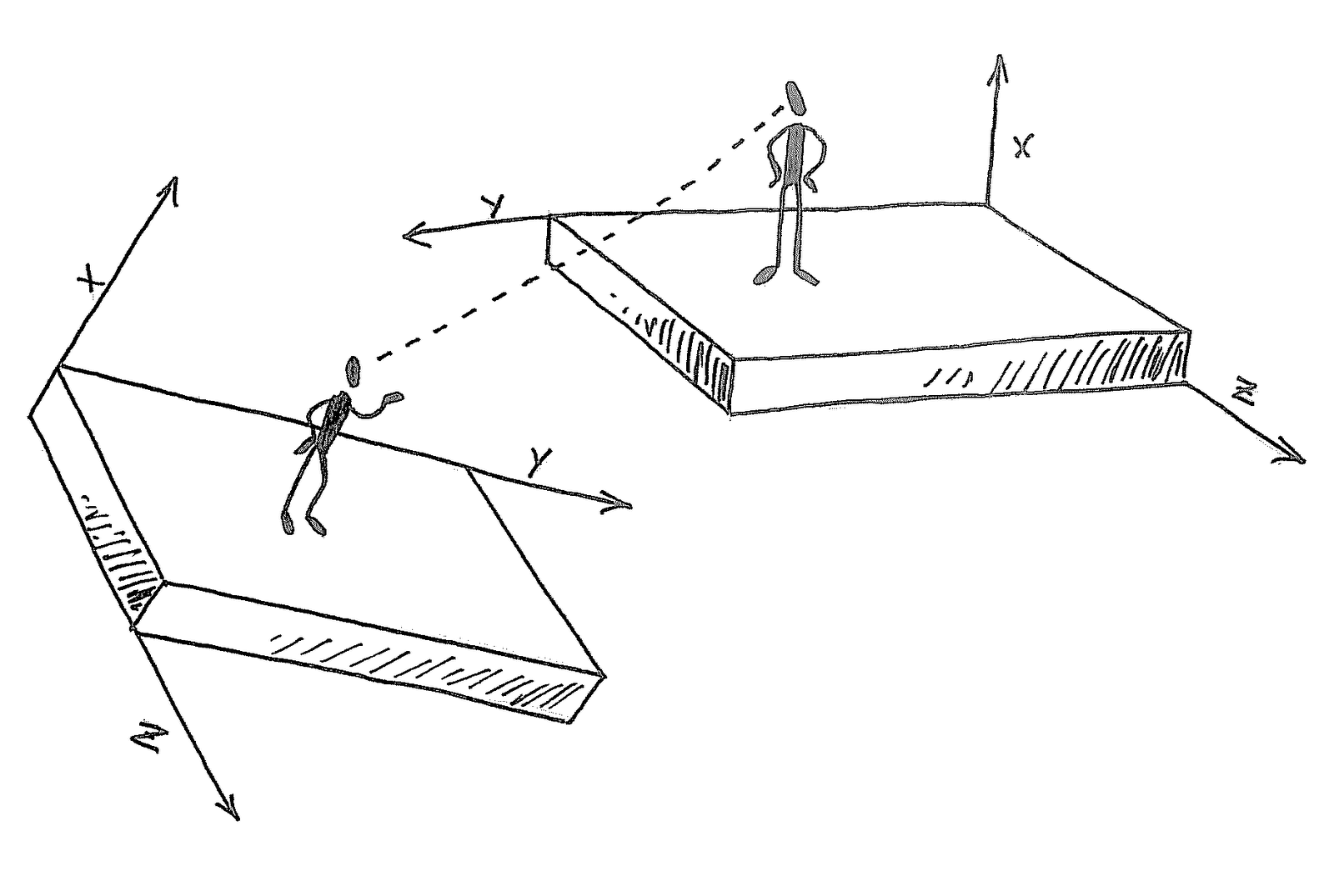
Ok, so we’re back to E=mc2 (Groooaaaaannnnnnn!- stay with me here, I think I’m on to something.) If you remember my talk before I used the phrase ‘inertial frame of reference.’ Think of it this way. Imagine two platforms placed at different angles to each other. (Ok- don’t imagine it- look at the picture below)

See how the lines indicating height, width, and depth (x, y, z) are all pointing in different directions? The ‘x’ of one platform doesn’t line up with the ‘x’ on the other platform. Each platform is a different ‘frame of reference.’ So, a scientist sits on the first platform, doing his little experiments and writing down his little math. Everything works pretty well- good enough for government work. He jumps over to the other platform, does the same experiments, writes down the same math, the numbers are a touch off but on the average they work about like they did on the first platform. BUT- while he’s on the second platform he looks across to his experiment on the first platform and notices that it doesn’t seem to work right all of a sudden- the math doesn’t work out. “Crap,” he says. “It’s different over here. When I’m on Platform 2 looking over at Platform 1 things don’t work out right. I bet there must be a platform where everything works out perfect and then that will give me the clue as to why the others don’t work out.” So off he goes looking for that perfect platform- the place where everything is ‘right’- the ‘inertial frame of reference.’ Long story short: he’s going to be looking for that ‘platform’ forever, ‘cause there ain’t one.

Along comes another scientist. We’ll call him…uhm…Einstein. “Hey, buddy,” Einstein says, “Let me show you something.” He points to a dotted line that was formed when the first scientist looked from Platform 2 to Platform 1 (and from Platform 3 to Platform 1 and so on and so forth- to and from every Platform he occupied in his search for THE Platform.) Einstein continued, “Those lines are a relationship between all those platforms. Now I’ve discovered this little equation that shows that all those relationships, those dotted lines connecting the platforms, are the same. So that leads me to conclude that there is no ‘One Platform’ that everything is based off of- the base is the relationship.”

When I looked at it this way I was blown away by the concept that the only constant was a relationship. You see, we all operate from our separate platforms- our own way of viewing the world that is the sum total of our genetics, our raising, our education, our memories, etc. And I’ve noticed that many problems between people arise not because one person is right or wrong but because there has been a misunderstanding from the fact that things look and sound differently when viewed from different platforms. Or problems arise because people’s sense of identity and security is wrapped up in the ‘orientation’ of their ‘platform.’ Therefore, any other viewpoint/platform is seen as a threat- defensive posturing and/or tense relations ensue. It’s my experience that human interaction is a result of ‘my platform’ vs. ‘your platform.’- we try to defend our platform or change other people’s platforms or we align with those whose platforms are the most similar to ours. Yes, even positive, healthy relationships result from this thinking- it’s just that the two platforms correlate enough to cause a minimal amount of friction (witness the plethora of online dating sites that attempt to match your ‘platform’ with someone else’s!).

What’s needed is an ‘E=mc2’ of human interaction – something that takes the focus off of ‘platforms’ and on to ‘relationships’. I feel the implications of this are huge (as evidenced by the physical ‘shudder’ I experienced coursing up and down my spine and throughout my entire body when I hit upon it.)- we’ll explore this further in my next post.

Thoughts on a Merger…A Merger of Thoughts

“Yeah, I might lose my job!” Words you don’t usually here. Yet, as odd as it sounds that’s kind of how I’m feeling at the moment. Let me explain. My employer, Mt. Hood Beverage, is merging with its cross town rival Columbia Distributing (and Gold River Distributing, a downstate “cousin” of Mt. Hood Beverage.) Naturally there are many, if not all, employees a little anxious regarding their job status. My status is in no way secure…yet I fail to share in the anxiety. Why, you ask? The short answer: because of ten years of reading books most people don’t care to read and learning things most people don’t take the time to learn. Allow me to expand…

Ten years ago I was working at a business leadership seminar company in Lexington, Kentucky. I was exposed to the ideas of a man named Tom Peters– in fact, I can say in full confidence that his book “Circle of Innovation” literally changed my life. One of his stock-in-trade ideas is that the ‘new worker’ is basically on her/his own. Mergers and buy-outs and reorganizations and what have you have taken away the idea of job security. The worker’s only ‘security’ is in the strength of her/his own resume of (hopefully) stellar work history and job performance. In this brand-laden society, each individual is her/his own ‘brand’ – ‘Me, Inc.’ In essence you are your own business entity, regardless of your status as self-employed or W-2 wage earner. As long as you are constantly striving to improve yourself, to learn new skills and/or to hone your current skills through a stream of successful, impactful projects then you can have the best form of security- the choice of employers from your ever expanding list of job offers. Being the independent type I was enthralled with the idea- with that image. However, he’s even come up to an endpoint in that idea. On page 315 of his latest book, Re-imagine, he ponders the question of what happens when the need for your skill set has been completely eliminated due to changes in technology or market trends or competition. At the time of his writing, he had no answer. I feel I do…

Enter life-changing idea/book number 2: Rich Dad, Poor Dad. I first saw this book in Abilene, TX when my manager at Oak Express (where I served for a short stint as a salesman) was reading it. I was intrigued and read a couple of pages, hoping to get my hands on it some time in the future. When I moved to Portland and hooked up with the world of investment real estate through the mortgage industry, I encountered the book again as it was one of the bedrocks of investors, especially real estate investors. (short disclaimer: to avoid being labeled as one who just jumped on the ‘Rich Dad’ bandwagon, I want to note here for the record that long before I read his thoughts on investing in general and real estate in particular, my wife and I had looked at our rent check going out and said, “We need to find out how to get on the ‘other side’ of this check. Because our landlords haven’t had to do anything, and every month they get a check from us!”) One of his ideas in that book is ‘Mind your own Business.’ Again, regardless of whether you are self-employed or other-employed, you are your own business entity. And your ‘business’ is building up investment income to give you security for when the employment income gets turned off (by disability, retirement, lay-offs…mergers… you get the idea). Businesses seek to obtain assets that keep them a viable business- a hedge against the down swings of an unpredictable market. Individuals-as-businesses should seek to obtain no less than the same.

And so, in the midst of this merger I ponder a merger of these ideas. Your job security does not rest in your employee name badge, but rather in your ongoing creation and re-creation of your resume of job performance. That way instead of being thankful that you’ve been hired (“Yeah, I got a job!”) you can trust in your abilities to get hired, and re-hired, and hired again, over-and-over (“Yeah, I have my choice amongst all these job offers!”). But ultimately, those incomes are merely the start- for in turn you, as owner of ‘Me, Inc.’ are also continually working to build up your assets to the point where your bills are covered whether you get a paycheck or not (“Yeah, I don’t need a job!”) That way, if and when your skills are no longer needed/wanted, you have an answer.

So I’m enjoying being part of a ‘history-making’ event (this merger is a pretty big deal). I’m enjoying witnessing the growth of an investment (bummer I’m not a shareholder). In artistic terms, seeing a company rise from $270 million in annual sales to an estimated $1.2 Billion in estimated sales is aesthetically pleasing- I am enjoying the beauty of it. And because I don’t place all my bets in the traditional ‘job security’ mindset, I’m enjoying the freedom of an educated mind- and look forward to what God brings from the education He’s provided me with (and regardless of what books I read or what things I relentlessly study, I believe they are things God is teaching me… but that would be a different post.)

And so in the immortal words of Michael Stipe: “It’s the End of the World as we know it… and I feel fine.”

Minotauromachy

Started reading a book called “The Power of Myth.” It’s an interview of a guy named Joseph Campbell conducted in the late 80s by Bill Moyer. Came across this passage, looked up the picture, and voila- a blog was born!

Moyers: I saw a photograph of this latest cult figure from Hollywood, Rambo, the Vietnam veteran who returns to rescue prisoners of war, and through violent swaths of death and destruction he brings them back. I understand it is the most popular movie in Beirut. The photograph showed the new Rambo doll that has been created and is being sold by the same company that produces the Cabbage Patch dolls. In the foreground is the image of a sweet, lovable Cabbage Patch doll, and behind it, the brute force, Rambo.

Campbell: Those are two mythic figures. The image that comes to my mind now is of Picasso’s Minotauromachy, an engraving that shows a great monster bull approaching. The philosopher is climbing up a ladder in terror to get away. In the bullring there is a horse, which has been killed, and on the sacrificed horse lies a female matador who has also been killed. The only creature facing this terrific monster is a little girl with a flower. Those are the two figures you have just spoken of- the simple, innocent, childlike one, and the terrific threat. You see the problems of the modern day.