All posts by michaelbrummett

FaithQuest 2010 – "Jesus as Alien"

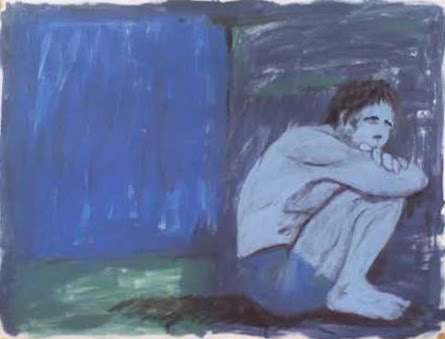
This series is regarding the paintings ‘performed’ during Faith Quest 2010.  The weekend revolved around a movie theme and the speakers played with different characterizations of Jesus as found primarily in the Gospel of John.  This painting was painted while Ryan Woods spoke on ‘Jesus as Alien.’

Alien doesn’t have to mean strange creature. Though that’s how we feel sometimes when we’re alienated. We feel like freeks. And perhaps what is worse is that we feel we are hemmed in by that thought that we’re freeks. In other words, we feel we can’t get out of it.

I wanted to show a Jesus like us. Not some dude in a robe with a stylish beard. But perhaps- more like a young person, with generic shorts (purchased cheaply at a second-hand store, of course) that don’t indicate race or nationality or time period. Because Jesus is everybody, everywhere, at everytime.

I was also thinking about Picasso. His first style that was uniquely his, before he started all the cubism stuff that became his claim to fame, was called The Blue Period. Simply because all the paintings were blue. Poor people (this was his ‘starving artist’ phase in life), destitute in their hopeless situations, are literally blue- saddened by their lot in life.

Picasso has a painting, I think it’s called the ‘Old Guitarist’ or something like that, that I was specifically thinking about. Artists sometimes use underlying grid lines to line elements up in their paintings. It’s a way of organizing the picture- just like you organize writings into paragraphs, or songs into verses and choruses. Picasso’s painting shows that organizational system very clearly. And I wanted to reference that.

So I organized it with a lot of empty space on the left. That space is broken up into a big space and a little space. The little space, then, is about the same size as the little space above the head of ‘Jesus’. And ‘Jesus’ occupies the same as the large empty space.

It organizes the space into a nice symmetry. But it also hems Jesus (or you) in. It alienates Him/you into the corner. And just like the labels of freak or alien, they keep us trapped in a (seemingly) hopeless situation.

But we know there’s a way out…

Art and Worship

My good friend Ike Graul awhile back told me he’s been asked to develop a ‘theology of music in worship.’ But he felt that was too narrow – it should be expanded to be a more inclusive ‘theology of art (including musical, theatrical, visual, etc.) in worship.’  It’s something I’ve been thinking about somewhat for awhile now,  but moreso the past few months.  I’ve ‘performed’ drawings at PUMP for several years, and have done so at Faith Quest for the past three or four years.  And honestly, I’ve been very concerned about certain aspects of me doing art in a church/worship context.  But this past weekend, at Faith Quest 2010 I had some great conversations with Ike, Matt Tibbles, my wife, and the speakers Jeff Medders and Ryan Woods.  So here are some of my musings and some of the conclusions I’m coming to.

My first issue probably has to do with illustration vs. more abstract forms of art.  Despite my initial lack of understanding of abstract art I am now true believer in the efficacy of abstract forms of expression.  So perhaps it was just a bit selfishness (and snooty-ness) on my part to be somewhat upset with that fact that the majority of a church-going audience does not understand abstract art.   Not only did I simply prefer to do abstract works, but it began to become a moral issue.  Let me explain.

I’ve always been able to draw well.  It has always come fairly easy to me.  So this created a couple of interrelated issues regarding talent.  One, abstract art being more challenging, I felt almost guilty doing something as ‘trite’ as a simple illustration.  I felt I wasn’t using the talent God gave me to the fullest extent, which I feel was not bringing honor to Him.  Second, to make matters worse, not only was I ‘settling’ for illustration, but because I was better than most people around me, I often was able to get away with a picture I thought, quite frankly, looked like crap even though it elicited ‘oohs’ and ‘aahs’ from the crowd.  Double guilt.

So in speaking with Ike I came to see art as a ‘tongue’ – as like a foreign language.  In I Corinthians Paul encourages those speaking in tongues to keep quiet if there is no interpreter as that would not edify the body.  So I felt that abstraction could be utilized more if there was provided at that time a means for interpretation.  Then it was pointed out to me that the Apostles spoke in tongues in Acts 2 and those who spoke those languages could understand them.  So… there may be people who get abstraction and I would be speaking to them artistically in a way that a speaker (verbal) could not.

But then I had an amazing, affirming weekend at Faith Quest.  The speakers were comfortable with me going a little more abstract and the response was tremendous.  And I discovered a hunger.  People were REALLY interested in some of the more abstract aspects – even though I had done some abstract stuff in previous years that didn’t seem to garner that much attention.  They seemed to crave the ‘secrets’ to the ‘mysteries’ of abstraction.  And it got me thinking.

We were singing a song about Jesus being a ‘marvelous mystery’ – so why didn’t it seem people craved the ‘secrets’ to the ‘mystery’ of Christ?  My initial thought is that we often think we have Jesus figured out- He’s no longer a mystery to us.  

But maybe there’s something else.

This might come out sounding conceited but stay with me.  I think the people responded to the art because of me.  I’m reminded of 2 Corinthians 4 – of ‘commending ourselves to the consciences of others by the open statement of the truth’.  If I hadn’t been openly worshiping God in this (visual) format for the past few years, I don’t think it would have had near the effect.  All of my anxiety over illustrative vs. abstract had nothing to do with it.  It’s about relationship.  Being open with my art and consistently, honestly doing my thing is what attracted people- people who seemed to crave the ‘secrets to the mystery’ of art but never felt compelled to darken the door of an art museum.

It’s not unlike Ike’s credo on musical worship:  God does not call us to create beautiful music- He wants a joyful noise.  It’s the open and honest presentation of who we are (good singer or not) that matters.

So here is what I’m coming to:  be hospitable with your gifts.  Be a people of peace through your gifts.  Whether people ‘get it’ or not, or connect with you or not, is not really your concern.  God will bring the people of peace that do connect with it into your life.  It’s not about the gift.  It’s about the openness, the honesty, the relationship.

On Human Interaction – part IV

I sometimes go back and read my old blogs. Usually my ideas are so ‘long’ that I sometimes forget where I started, but I know I need to continue a strain, or pick up a tangent, or something so that I have to do some research. What I felt was that I didn’t end this series well. If you’ve followed it you may have felt as I did when I re-read part III– “He seems to feel that this is some big deal, but it really doesn’t seem that way to me.” I still think it is a big deal, but I failed to convey that convincingly. Allow me another go ’round- with a real live example.
My wife and I had a pretty major row once (well, I guess more than once, but you know…). Anyways, I threw a fit that, admittedly, was rather childish. But I was feeling extremely hurt because of how things – actions and words performed by my wife- were coming across to me. Now to protect her, I won’t go into any details but let me just share what I was feeling. Generally in the midst of our ‘conversations’ we both end up apologizing because, let’s face it, it takes two to Tango- so if there is an argument I feel there is always something that BOTH parties did that contributed. I hope we can all agree to that. (At least in theory, until the next time when you’re right and someone else is wrong… right?)
Anyways, on the heels of her part of the apology came the truthful indictments of my childish behavior. Now I’m not denying them; I’m not saying that how I acted was healthy and sane- because it wasn’t. But when I hear such constructive criticism in the same context as an apology- it kind of ruins the flavor of the good parts. Like trying to taste food when you have a cold- everything tastes like snot. So I tend to discount the apology somewhat because it sounds conditional. “I’m sorry,… BUT YOU yada yada yada!” I don’t know about you, but that always has the effect of me feeling like I wasn’t really heard and that it’s all my fault, with a little apology thrown in to make it sound nicer. Have you ever felt that way?
It was frustrating me because such interactions always seem conditional. “I’ll apologize only if you say you’re wrong about your behavior.” But here’s the crux of the matter- I discovered I am just as conditional- “I’ll only accept your apology as long as you don’t criticize my actions.” And isn’t that what it’s really about- the conditions? There is a multi-billion dollar industry on self-help and communication- how to talk to yourself, how to talk to others, how to express your feelings, how to set your boundaries, etc., etc. Now, I’m all for learning phrases and techniques to aid in communication. But when you reach a point where you realize that you need someone to speak to you a certain way for you to take them seriously- then you’ve just seen the presence of your platform. And most of the time we don’t realize it because we are following the advice of all the trained psychologists and counselors who are ‘experts.’ They are experts- but only in a different context. They’re of this world; I’m trying to get at Kingdom stuff. Their platform doesn’t fit what I’m coming to understand as the ‘non-platformness’ of Kingdom existence.
Because your platform is your identity. And if you are needing to be spoken to in a certain way, or if you only speak to others in certain ways, then that is your platform interacting with your communication style. It is what you need to maintain your identity. So, again, what does this look like- when we’re not operating from our platforms? What if our actions had nothing to do with what we need? What first needs to happen, though, partially to underscore it’s overarching significance, is to raise our awareness of our ‘platforms’ – similar to what happened to me in the argument with my wife. I’ll try to flesh this out more in future posts…

Mark Nine

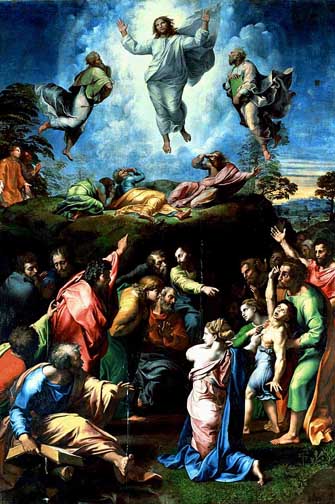
So I read to my kids from the Bible every night. Tonight’s reading du jour was from Mark 9 – the Transfiguration story followed by the Healing of a Demon-Possessed Boy. Reading it made me think of this painting by Raphael.

Now, I personally am more of a fan of Michelangelo and Leonardo, on whose gigantic shoulders Raphael stands. But he was no slouch either, particularly when it came to composition- arranging the elements of his paintings into a cohesive whole. One thing artists always do is lead the viewer’s eye around the whole picture. So the way things line up and where they point to are little devices to leave a trail for your eye to follow. One device Raphael liked to use was a figure eight. Here the top half of the eight is the Transfiguration scene, the bottom half is the crowd having a fit about the demon-possessed boy. Now it’s easy to focus on Jesus- He takes center stage and is encircled by the billowing clouds that echo the ‘lines’ made by Moses, Elijah, and Peter, James, and John. Below, however, the scene is more chaotic, and the ‘star’ of the show, the demon-possessed boy, is off to the right. But here Raphael helps us out by splitting the crowd of people in two, the black expanse between the two groups is punctured by a pointing hand that leads our eyes directly to the boy’s face. More subtly is the looping of the bottom half of the eight (which, perhaps not incidentally, is an infinity symbol). If you look at the disciple in blue and yellow in the center of the painting, follow his left foot, point to the right, across the black expanse to the upraised hand, down the arm of the demon-possessed boy, along the edge of the garment that crosses the kneeling woman’s back which leads to the outstretched hand of the man in the lower left corner of the painting. Follow his arm up to the man behind him, up his arm and along the back and arm of the man in red, which follows a direct path along the disciple in yellow’s (where we started) bent right leg, and on up around Moses, Jesus, and Elijah, and back down and around again.
These formal devices make for a nicely constructed painting. But perhaps my favorite connection is more conceptual in nature- it has to do less with holding the picture together than it does in conveying meaning. With all the activity going on it’s helpful to look at the people’s eyes- what are they focused on? It’s telling that the little boy, the one who’s having a rough time and needs, seemingly, the most help, is the only one whose eyes are focused on Jesus.

Phone Art

So for awhile now I’ve engaged myself in an ongoing ‘art project’- I take pictures that ‘strike’ me with my camera phone and set them as the wallpaper background to my phone. I keep it there until I come across another random ‘work of art.’ Then I take another picture and set up a new wallpaper. Thought I’d start sharing what my eye finds.

Chris Burden- Part III

“After Newsweek and all the publicity came out, I had to stop doing those things because I couldn’t keep doing them in the light of that kind of publicity.” –Chris Burden

I mentioned in the last post the idea of power- the power one would need over their mental and emotional responses to situations. In this case Chris Burden had to exert extreme measures of will power to deal with his self-imposed ‘stress tests.’ Power over self. Power over situations. Power over others. By and large, this is what Chris Burden’s work centers around- although now he does it by less violent means. So to wrap up my discourse on him I’ll share with you a couple of generally ‘non-participatory’ pieces. I say generally because many of them still contain some element of an action that needs to be performed, or the pieces are somewhat kinetic. But they’re not ‘Performance Art’ in the classical sense.

The first piece is called ‘Big Wheel.’ It has this huge wheel (probably about 6’ in diameter). Next to it is a motorcycle.

Somebody (it could be the artist, a museum guard, somebody) starts the motorcycle and backs it up to where the back wheel (the ‘drive’ wheel) is placed against the Big Wheel and sets it spinning. Then the ‘natural powers’ of momentum and friction take over (who ever said science and art are opposites?). The weight and speed of the wheel are such that it will spin for about two-and-a-half hours before the friction in the bearings slowly bring it to a stop. At which point the motorcycle can be started up again…

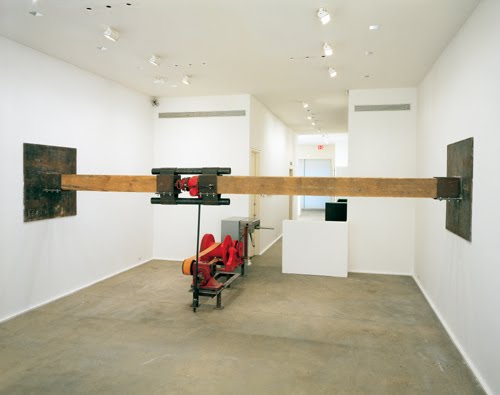
Another piece is titled ‘Samson.’ Named after the Biblical Judge whose last act was to push down the supporting columns of a building killing himself and all of the Philistines within the structure, this sculpture aims to bring that scenario to life.

Massive beams are placed against the load bearing walls of the museum space. The beams are connected with a device that is in turn connected to a turn-style. Visitors to the museum must walk through the turn-style to view the rest of the exhibition. With each rotation a gear is notched in the jacking-device, pushing the beams further apart and putting more pressure on the walls, purporting to tear the museum down- with you in it…

The final piece is called ‘The Flying Steamroller’ and it is Art-meets-Engineering at it’s finest. There is just an odd sensation that occurs when you see a 12-Ton hunk of machinery ‘effortlessly’ gliding through the air. Check it out…

This kind of bare bones presentation of the facts (the facts here being a wheel that turns until it slowly comes to a stop or a steam roller flying) is the kind of stuff that often brings the comments “this is art?” or “I can make something like that!” The answer to both of those questions is ‘Yes!’- yes, it is art and yes, you can make something like that. The real question is, then, why haven’t you? Let’s explore that a bit.

As an artist I look at things differently. Often, this different viewpoint is appreciated by others who ‘would have never thought of that.’ Yet- despite that appreciation, validation of me as an artist still predominantly rests on my ability to draw or paint a picture that ‘looks real.’ Most people’s focus on art is on the mechanical aspects eye-hand coordination. Don’t get me wrong- I’ve come to appreciate that as a very special, unique skill. But the value of art is so much more. I’ve seen some people who can draw circles around everybody else, but I don’t feel they are very artistic. And others who I feel are extremely talented artists who couldn’t draw worth beans.

To me, art is thought made visible- and by thought I mean both the rational, cognitive logic and the seemingly illogical processes of emotion that nonetheless play a considerable role in our ‘thinking.’ Good art is the ability to display a certain point of view with a powerful resonance. The natural ‘powers’ of friction, weight/gravity, force, etc. are extremely powerful when you stop to really think about them. And I think there is no doubt that Chris Burden’s presentation of them carries a very palpable resonance, a presence that is as much (if not more) felt than seen. Symbolically speaking these physical forces are no different in action than other forces in our lives- the role that values and beliefs play in how we interact with the world. What moves us or slows us down. The pressures and the frictions in our lives. The things we value and how we are drawn to or repelled from people, places, or things because of those values.

So as you go about your day, I encourage you to look around you and try not to get caught up in what things are. But rather, look for what has presence; what has resonance? What affects you? What are these things doing? That is art.

“Whatever it is that Burden thinks he is trying to do, he has forced me to rethink the values by which I live, and for that I am deeply grateful.” -Robert Horvitz

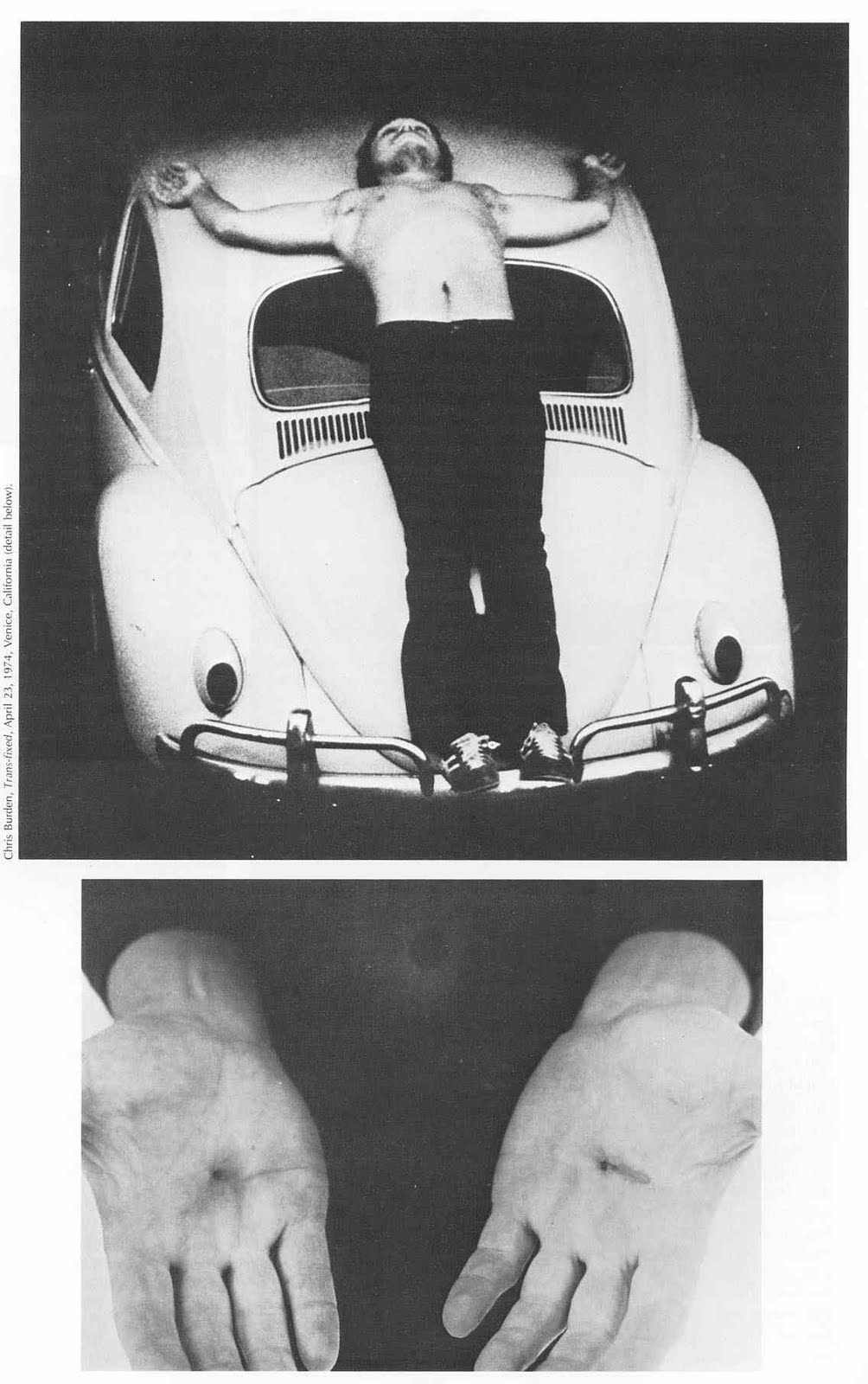
Chris Burden – Part II

So I was doing some ‘research’ and looking back at some of my past blogs and realized that I left all (three) of you hanging. When I introduced the artist Chris Burden I promised a part II and a part III. Then I got sidetracked by other pursuits. You can stop holding your breath now.

When I come across an artist that really strikes me- for good or for bad- I usually throw myself into their life and work to try and get a handle on what they’re all about. Especially if they have garnered a considerable amount of critical acclaim- which Mr. Burden has. So first here’s a quick re-hash of some of his performance pieces:
5 Day Locker Piece- “University of California, Irvine, April 26-30, 1971: I was locked in Locker Number 5 for five consecutive days and did not leave the locker during this time. The locker measured two feet high, two feet wide, and three feet deep. I stopped eating several days prior to entry. The locker directly above me contained five gallons of bottled water; the locker below me contained an empty five gallon bottle.”
Shoot- Probably his most famous piece where he had a friend shoot him in the arm with a .22 rifle. Want to see it? It was filmed. The video starts out with just a black screen while the artist talks about the piece (very quietly)- then all the action happens in the final 8 seconds.
Through the Night Softly- “Main Street, Los Angeles, September 12,1973: Holding my hands behind my back , I crawled through fifty feet of broken glass.”
Kunst Kick- During an Art Fair in Basel, Switzerland, Burden was kicked down a flight of stairs.

Doorway to Heaven-“November 15, 1973: At 6 pm I stood in the doorway of my studio facing the Venice Boardwalk, a few spectators watched as I pushed two live electric wires into my chest. The wires crossed and exploded, burning me but saving me from electrocution.”
Proponents of modern and contemporary art- including the artists themselves- often shy away from saying what artworks ‘mean’, insisting that the important thing is what it means to the viewer- a very relativistic stance befitting our pluralistic society. And while that approach has merit, I am particularly interested in the artist’s ‘platform’ – what was the perspective and the process of thinking that led to this ‘artistic conclusion’ that is the work of art? Certainly certain works have a special meaning to me regardless of the artist’s intent, but I usually like to qualify my own feelings with the artist’s intent. Chris Burden’s work is a case in point. I’m certain that he had no thought of Christian parallels in his work, which are some of the meanings they hold to me, but I couldn’t arrive at my own meanings without first delving into what he thought and was attempting to achieve.
So here are some things that Chris Burden said in relation to his work:
“I don’t think I’m trying to commit suicide. I think my art is an inquiry, which is what all art is about. “
“One thing that sort of bothers me is that a lot of people remember the Shoot piece and some of the violent pieces, and then ignore the reason for it all, the whole thing that ties it all together. They get carried away with ‘There’s this guy who had himself shot!’ They don’t go to the next step and wonder why I would want to do that, or what my reasons are.”
“I never feel like I’m taking risks. What the pieces are about is what is going to happen. Danger and pain are a catalyst- to hype things up. That’s important. The object is to see how I can deal with them. The fear is a lot worse than the actual deed.“
“It was more like a kind of mental experience for me- to see how I would deal with the mental aspect- like knowing that at 7:30 you’re going to stand in a room and a guy’s going to shoot you. I’d set it up by telling a bunch of people, and that would make it happen. It was almost like setting up fate or something, in a real controlled way. The violence part really wasn’t that important, it was just a crux to make all the mental stuff happen… The anticipation, how you dealt with the anticipation.”

The clincher was his resolution to do it- and how that dictated his actions until that decision reached its culmination. At the time I read that quote I was going through a study of the book of Luke. In Luke 9:51 it states that Jesus ‘resolutely set out for Jerusalem.’ And it hit me- Jesus made the decision and it dictated His actions throughout his life and ministry.

Pause for a little art history background. In the mid to late ‘60s there were a group of artists, often referred to as ‘Post-Minimalists,’ who were engaged in making ‘Process Art.’ Jackson Pollock had somewhat initiated the idea of ‘acting’ upon the canvas- with his splashes, drips, and splatters- rather than just painting a picture. So these ‘Process Artists’ extended that line of thinking into sculpture by taking materials and subjecting them to some sort of ‘process’ or action and the resulting change in the appearance or nature of the material would be the final product. So instead of trying to make something, artists – in the activist spirit of the ‘60s- did something, and the artwork was a result of that action or activity. Now let’s extend the concept of material a bit- from a physical substance to something that is mental or emotional. The human figure has all the physical properties of any other material- density, mass, texture, color, etc. But it also has a psychological aspect to it that a piece of metal or wood does not have. So I think what Chris Burden was doing was an extension of this concept- what process or activity could he do that would bear upon the psychological and emotional aspects of the ‘material’ of the human figure?
So with that thought in mind I think of verses like Luke 12:50 – “But I have a baptism to undergo, and how distressed I am until it is completed.” Similarly, in Matt. 26:38 Jesus exclaims, “My soul is overwhelmed with sorrow to the point of death.” In contemplating Chris Burden’s ‘experiment’ on the properties of his ‘psychical material,’ I was actually given more insight into these statements by Jesus.
If you suspend your judgment that Chris Burden is insane, and instead look at the weight these actions he performed would place on him, mentally and emotionally, you can get a different sense of things. What would it take to go through with the things he went through? And what sort of resolve, control, or sense of power would one need to submit to these physical and mental tortures?
And now think of Jesus.
What would it take to be able to make the decision He made, and go through the things that He did? For me, it makes His sacrifice all the more profound. And God revealed that to me…through Chris Burden’s art.


Encouraging Words

So I read to my boys every night as they’re going to bed. Wanting to expose them to ‘the best’ (and giving myself an excuse to read them) I’ve decided to hit on some ‘classics.’ So our first entry in this endeavor is ‘Robinson Crusoe’ by Daniel Defoe.

I’m blown away by the depth of insight in this book into the nature of faith in God. So I decided to post an example. To fill you in, Robinson Crusoe’s been stranded on this island for about 24 years now and he’s made contact with a group of cannibals. One he is able to, in a sense, capture and make him his servant. His name is Friday. So he is trying to teach Friday about God. And here were words I found enlightening and encouraging.

“Here I was run down again by him to the last degree, and it was a testimony to me how the mere notions of nature, though they will guide reasonable creatures to the knowledge of a God, and of a worship or homage due to the supreme being of God, as the consequence of our nature; yet nothing but Divine revelation can form the knowledge of Jesus Christ, and of a redemption purchased for us, of a Mediator of the new covenant, and of an Intercessor at the footstool of God’s throne; I say, nothing but a revelation from Heaven can form these in the soul; and that therefore the Gospel of our Lord and Saviour Jesus Christ, I mean, the Word of God and the Spirit of God, promised for the guide and sanctifier of His people, are the absolutely necessary instructors of the souls of men, in the saving knowledge of God, and the means of salvation…
I had, God knows, more sincerity than knowledge in all the methods I took for this poor creature’s instruction, and must acknowledge what I believe all that act upon the same principle will find, that in laying things open to him, I really informed and instructed myself in many things that either I did not know or had not fully considered before, but which occurred naturally to my mind upon my searching into them for the information of this poor savage;… and when I reflected that in this solitary life which I had been confined to, I had not only been moved myself to look up to Heaven and to seek to the Hand that had brought me there, but was now to be made an instrument under Providence to save the life and, for aught I knew, the soul of a poor savage, and bring him to the true knowldedge of religion, and of the Christian doctrine, that he might know Christ Jesus, to know whom is life eternal; I say, when I reflected upon all these things, a secret joy ran through every part of my soul, and I frequently rejoiced that ever I was brought to this place, which I had so often thought the most dreadful of all afflictions that could possibly have befallen me.”

After I read this Trevor was confused about what exactly gave him the the joy and it was great to share a verse he is well familiar with- our previous Dwelling in the Word passage from 2 Corinthians- “Therefore, since it is through God’s mercy that we are engaged in this ministry we do not lose heart.” Robinson Crusoe felt this mercy, to be engaged in the ministry of sharing Christ, and in the midst of his ‘dreadful’ predicament on his island, it gave him hope.

May God bless you on your ‘island.’

Lesson from Finances: Part III – Fatherhood Strategic Plan

I like threes. There is a fundamental drawing principle called ‘triangulation’- where you’re always comparing one part of the drawing to two other parts, thus creating a triangle of reference. So I figured a Part III was in order.

I love my children… and sometimes I want to ‘strangle them.’ Not literally but you parent types know the feeling. In their search for limits my repeated ‘No’s’ have the unfortunate corollary in me discovering my limits. I have yet to witness that as being a pretty sight.

But for some reason, very early on I was blessed with the idea that the ‘solution’ was not to yell less, or punish less severely, or remove whatever behavior I was exhibiting. Partially because I noticed that the more I concentrated on removing that behavior- the more I did it! So I made a decision to consciously create positive experiences with my kids. I needed to initiate play times. I needed to learn about their toys and become interested in what they liked. I needed to engage them in conversation and share things with them. I had hit upon the ‘Balance Sheet’ idea long before I even knew what a Balance Sheet was (which, on a side note, seems true of many ‘Big Ideas’- the break throughs are often when someone was able to codify and articulate something they had been doing intuitively all along.).

What I’ve found is that often the best (or most convenient) times to initiate those interactions are in place of the previously listed negative behaviors. If I find myself frustrated with my kids and the anxiety is rising- I try to take a quick stock of how often I’ve initiated positive contact with them. I often find a correlation, and I’m getting better at substituting positive behavior rather than reacting with negative behavior. Or at the very least I try to follow up negative behavior with positive interaction.

[HEY!!! WILL YOU CUT THAT OUT! BE QUIET!!!! CALM DOWN!!!! KEEP YOUR HANDS OFF EACH OTHER!!! BEHAVE- CAN’T YOU SEE I’M TRYING TO WRITE A BLOG, HERE?!!!!!!!]

…..*sigh*

Lesson from Finances: Part II- the Spirtual Side

I’ve always been struck by Luke 11:24-26. An evil spirit leaves a person, searches around but can’t find any place to go so it decides to go back to the original person and finds him/her like a ‘house swept clean’- so the spirit grabs its buddies (seven of them) and make the person worse off than before. Not exactly a happy picture- especially if you’re trying to rid yourself of your personal demons.

But if you’re in the business of helping people rid themselves of their demons- what an opportunity! To wit: the $11 Billion Self-Help Industry. (Just think about it- based on the above parable you can help someone oust a demon…and expect your business to increase seven-fold!!)

I mean- it’s the American Way, right? We want to have a better, smarter, slimmer, more beautiful, less stressful, happy-happy-joy-joy life so we identify what’s in our way, name it, formulate an action plan designed to rid ourselves of it, execute our plan- and voila!- seven more demons! (with seven more names, seven more action plans,…)

I don’t think it’s working- and this saying by Jesus alerted me to it. And it got me thinking that maybe the issue isn’t getting rid of sin but something else…

So I like the financial approach that I alluded to in Part I of this little mental exercise. Again, I’ll turn to the example of Warren Buffett, a man who doesn’t like debt per se, but doesn’t focus all his efforts on getting debt out of the way- in fact it appears as one of his last resorts: “So our main capital allocation moves in 1986 were to pay off debt and stockpile funds. Neither is a fate worse than death, but they do not inspire us to do handsprings either. If Charlie [Munger- Vice Chairman of Berkshire Hathaway] and I were to draw blanks for a few years in our capital-allocation endeavors, Berkshire’s rate of growth would slow significantly.” In other words, only when he had no other ideas of what to do with is money to generate wealth did he turn to paying down debt. I’ve heard many financial advisors claim that the fastest way to wealth is to pay down debt. Though they include investing in their wealth building plans their holy grail seems to be the ‘get-rid-of-debt solution.’

The problem is- getting rid of debt doesn’t necessarily get rid of the ‘debt-accumulating’ tendencies that got someone in debt in the first place. Like the poor sap in Jesus’ parable, getting rid of the demon did nothing to prevent its return (in fact in seemed to make the return even more attractive!)

If, in financial terms, the trick is in buying assets rather than eliminating liabilities perhaps the spiritual trick is spending less time ousting demons and more time ‘investing’ in ‘spiritual assets.’ I figure that if I increase spiritual activities that produce positive, spiritual income, my liabilities will eventually erode, or at least have a diminished effect relative to my enlarged ‘spiritual capital.’

As a general guide I’ve been taking the Spiritual Disciplines as the assets I’m targeting to acquire. I’ve been most successful with daily time in the Word, and am looking, in particular, to increase my ‘stakes’ in Prayer and Fasting. In effect I want a “Spiritual Statement” to read like so:

Instead of spending my time ousting my demons (or even trying to ‘work harder’ to be more loving, forgiving, self-controlled, etc- the spiritual equivalent to trying to get more income from your job), I’m wanting to focus more of my time on building up spiritual assets that will naturally make me more loving, forgiving, self-controlled, etc. In other words, the Fruits of the Spirit will be exactly that- the fruits/income from my time in the Spirit (via the spiritual assets).

So now I’ve thrown the gauntlet, publicly, to making this activity, which I’ve been kicking around in the back of my head for a couple of years now, a more intentional activity. And though I didn’t originally think of this as a New Year’s resolution- the timing fits. So here’s to your efforts to increase your spiritual investments.