All posts by michaelbrummett
Faith Quest 2011_2
![]() |
| Laundress by Jacob Lawrence |
I could probably go on with other associations and things I thought about – some premeditated, some discovered after the fact. But the real point is the amount of thought that goes into a work of art. Maybe we would do well to put as much thought into our own lives. Both thinking ahead of time how and who we will be. But also being aware (looking on the horizon for Jesus) and making adjustments in the process of living.
FaithQuest 2011
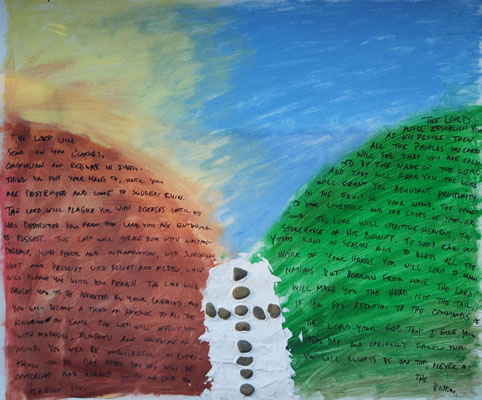
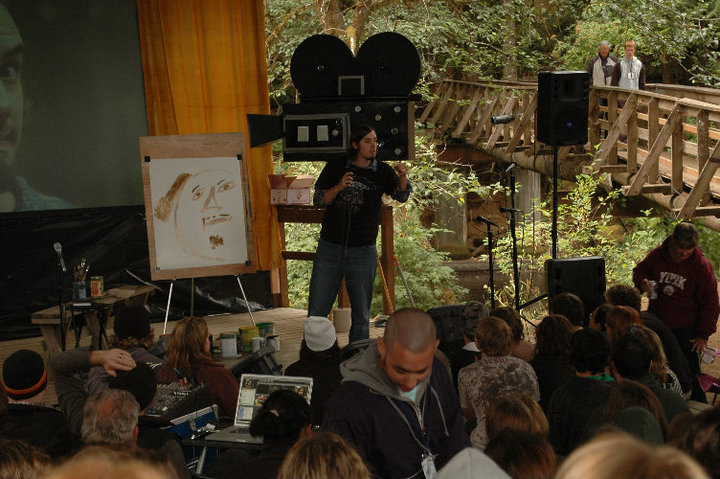
Every year Melinda and I help out at a youth event called Faith Quest. We help design and build the stage setup and then I do a series of paintings while the featured speakers give their talks. This year the theme was the Oregon Trail and the talks centered around the Israelites journey into the Promised Land. Troy Wagner presented the opening lecture on the relationship between Joshua, who led the Israelites, and Jesus who leads us.
What’s in a name? The Hebrew word for Joshua is Yeshua. When you translate that into Greek you get the name Jesus. Joshua led God’s people into the promised land. A land that they did not earn; a land they merely received based on God’s promise to Abraham. Jesus also leads us into a promised land. It is also a reward that we didn’t earn. I think there is significance in the name of Jesus. Literally it means ‘He Saves.’ And it was just as true for the ancient Israelites as it is for us.
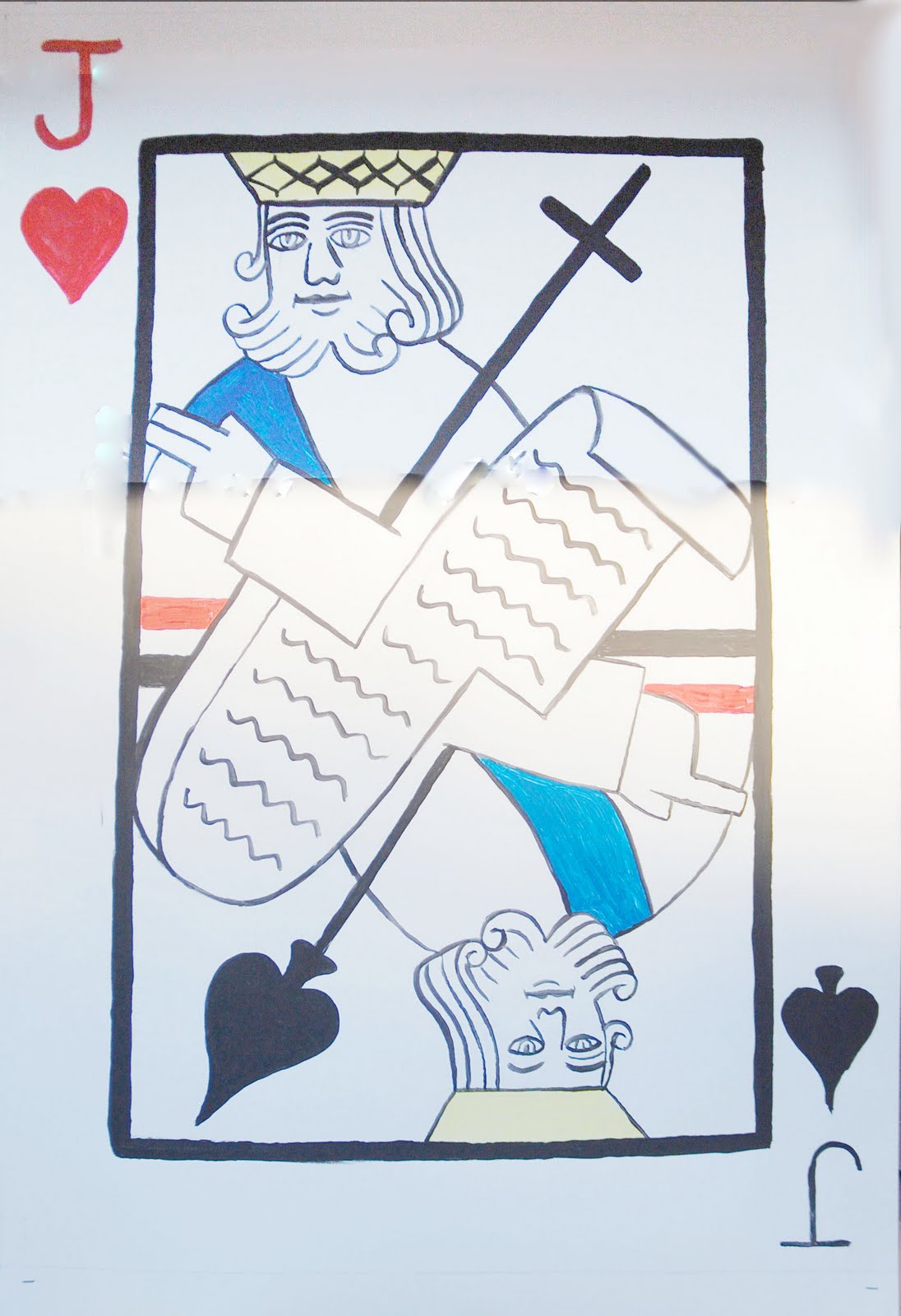
So God is beyond time. There is no backwards or forwards; beginning or end. So how do you visualize that? How do you show an eternal plan with no beginning and no end? And yet there are two individuals that serve as signposts to this larger picture. Two individuals that share the same name. And it occurred to me that playing cards have this sense about them. No matter which way you turn them they are always ‘right side up.’ They never end.
So then all these things came together- I used a king’s face because Jesus is a king, and Joshua acted in a kingly role in leading Israel into the promised land. But then I made it a ‘Jack’ since their names started with ‘J.’ Throughout the NT you see references to what the “Law and the Prophets” said. Joshua carried the Law- the stone tablets- with them into the Promised Land. Jesus announced his ministry with the reading of a scroll from the Prophets- proclaiming release for prisoners and sight for the blind.
To emphasize the inclusiveness of God’s Kingdom I also thought I would represent both black cards and red cards. So Jesus has a heart (because, you know… the whole ‘Jesus loves you’ thing) and Joshua is a spade because it serves as the point of his spear as he leads the Israelites into battle. His finger is pointing to lead the charge. Jesus has two fingers pointing in blessing. I’m not sure where it came from but whenever you see pictures of Jesus from, like, the Middle Ages and in icons from Eastern Orthodox traditions you have everyone raising two fingers in blessing. I thought I’d allude to that artistic heritage as well. Also, instead of a spear, Jesus leads us by example through His death on the cross.
Hopefully this gives you a different way to think about Jesus, Joshua, and God’s plan. But here’s something else about the power of art: by taking the image of a playing card, the next time you’re playing cards you just might remember this painting, and thus think about Jesus.
Renovatus Jesus
The Best Advice I Ever Received
I’ve been thinking a lot about marriage recently.
It’s something Melinda and I talk about quite a bit, actually. But we don’t just talk about our marriage- we talk about marriage in general. And I think that is key. And it reflects a perspective I gained when hearing what I consider to be the best advice I’ve ever received.
Melinda’s father performed our wedding. But living in a different state at the time, he could not have us in a full pre-marital counseling program that he usually liked to have with couples. But there were a couple of things he really wanted to say to us so one time while they were out visiting before the wedding, he gave us his ‘crash course’ in marriage.
![]() |
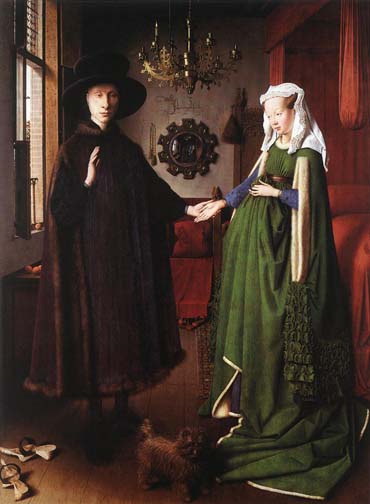
| The Arnolfini Wedding by Jan Van Eyck |
Now, I’m all about gaining new perspectives. It’s what fascinates me about and draws me towards art. Because you are able to gain new conceptions of seemingly mundane, ordinary things. We all have ideas about how things are supposed to be. Whether we’re fully conscious of it or not, we have images in our head- be they abstract signs of relationships or clear pictures of people, examples that embody our ideal. I wasn’t really conscious of my images of marriage at the time- most likely I had pictures of my parents’ relationship. But I was about to become aware of a new vision, a new conception of marriage that continues to affect me to this day.
In this ‘crash course,’ my future father-in-law said that in marriage there are actually three commitments- one is to God, one is to your spouse, and one is to… marriage. Having grown up Christian, the commitment to God was a no-brainer. And the commitment to your spouse? Duh! But a commitment to marriage itself gave my brain a little twist. Marriage was a separate entity that was beyond Melinda’s and my relationship to each other. But that separate-ness has made a huge difference in our relationship.
We all get mad at our spouse. We are never going to agree all the time. And sometimes it is difficult to love the other person. And for those reasons, if the marriage is only about your relationship with that person- how you’re feeling towards them, or how they’re feeling about you- then I fear the marriage could very easily be derailed. But when I think about the marriage– about what is required for a good marriage, then a whole new dynamic develops.
I’ve noticed at least two main benefits from taking this perspective. First, I’ve done things that I wouldn’t have done just based on my moment-to-moment feelings. It has compelled me to stand back and look at what a good marriage is and given me a yardstick with which to measure my performance. If I just stayed with how I felt, I could probably come up with many things to complain about. Perhaps those complaints would develop into anger and bitterness. And, of course, I’m sure I would never be at fault because we never blame ourselves when we’re just looking at our feelings. Right?
The second benefit is thankfulness. When I compare my performance with a yardstick that is not emotionally charged, I find all the ways in which I’ve been a poor, miserable slouch (to put it mildly) and I feel truly thankful and blessed that my wonderful wife has put up with me and still chooses me on a daily basis. But wait- what happened to all the blame and hurt and bitterness alluded to in the last paragraph? That’s right, it can’t be sustained when you have a clearer picture of things. And when I’m truly thankful for my wife, it’s MUCH easier to love her than when I’m angry at her.
So to sustain a good marriage, I can’t just look at how I’m feeling. I have to look at marriage itself- and sustain my commitment to it.
In this season of reflection and resolutions, I encourage you to take stock of your commitments- and regardless of your feelings- commit to that ideal.

FaithQuest 2010 – "Jesus is the Story"
This series is regarding the paintings ‘performed’ during Faith Quest 2010. The weekend revolved around a movie theme and the speakers played with different characterizations of Jesus as found primarily in the Gospel of John. This painting was painted while Jeff Medders spoke on ‘Jesus is the Story.’
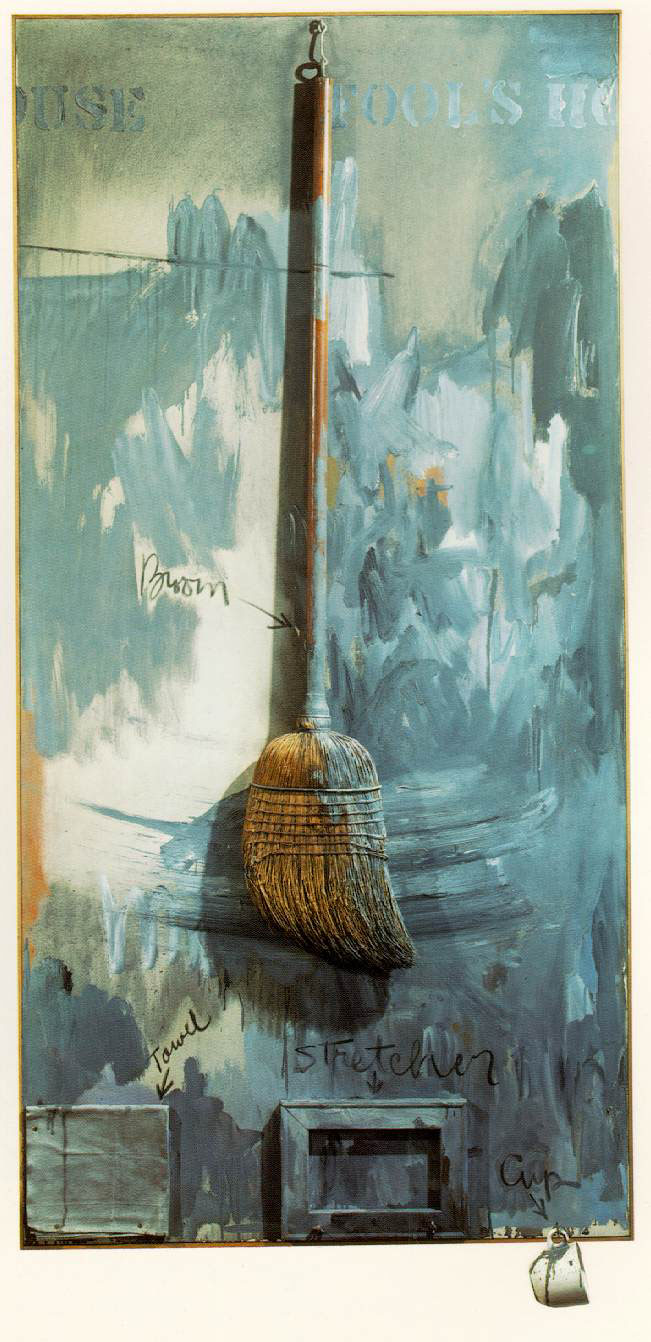
So I picked up something from an artist named Jasper Johns. He would sometimes include writing or words in his paintings. But often he would start a word on the right side of the painting but then have the word ‘wrap around’ and finish on the left side. It was the complete opposite of what painting had been trying to do up until that point. Before you went from a picture that looked like a view out of a window. You knew the scene goes on past the edges of the painting even though everything is framed nicely within the picture. The Impressionists took it even further by actually having people and objects cropped by the edge of the painting- similar to the way a camera does (Hmmm… can you guess what period the camera was invented?)
FaithQuest 2010 – "Jesus as Substitute"
This series is regarding the paintings ‘performed’ during Faith Quest 2010. The weekend revolved around a movie theme and the speakers played with different characterizations of Jesus as found primarily in the Gospel of John. This painting was painted while Ryan Woods spoke on ‘Jesus as Substitute.’
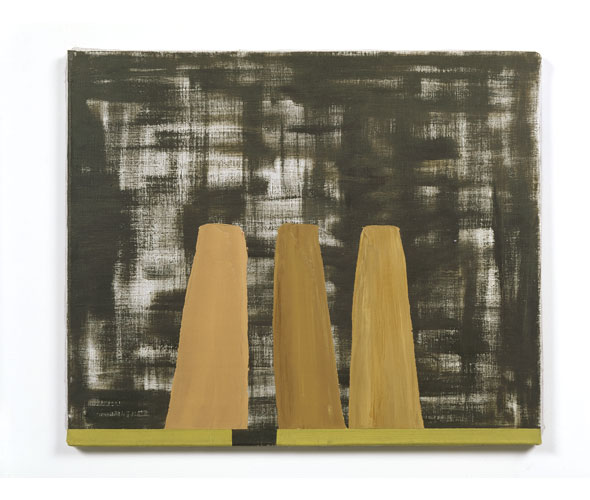
FaithQuest 2010 – "Jesus as Refugee"
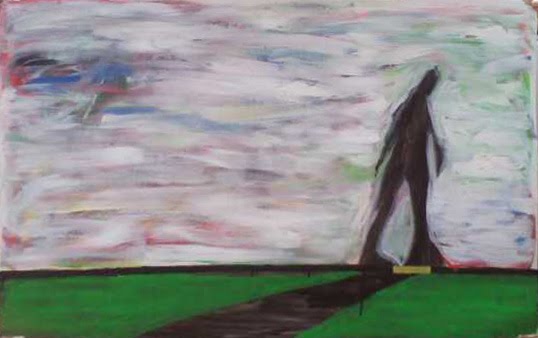
This series is regarding the paintings ‘performed’ during Faith Quest 2010. The weekend revolved around a movie theme and the speakers played with different characterizations of Jesus as found primarily in the Gospel of John. This painting was painted while Jeff Medders spoke on ‘Jesus as Refugee.’
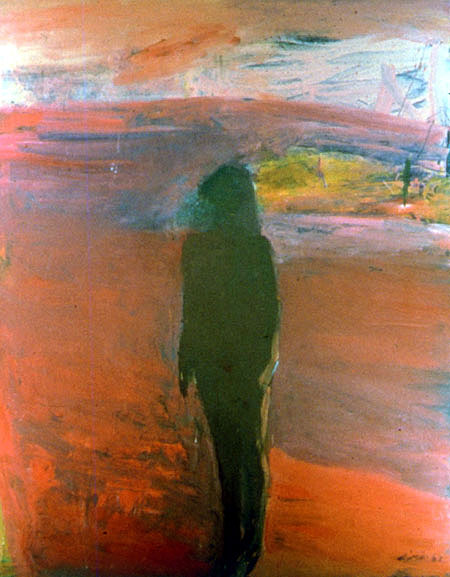
The imagery is culled from a combination of two artists- Nathan Olivera and John Millei. Nathan Olivera has several paintings of figures standing in an abstract space. His figures aren’t usually walking anywhere. Even if they are they are vertical in orientation- the orientation of portraiture, of being. Horizontality is the orientation of landscape, of journeying. But the psychological aspect of his paintings are powerful, and I wanted to tap into that.
In a couple of his paintings he incorporated either a gap in the ‘walkway’ or at least a section that had a different color. And when I saw them, I was struck by the intensity of the relationship between the figure and this little space. Most poignant for me were the times when the figures seemed to be just inching over the edge of this space. So I tried to incorporate that in my image. And the placement was important- it has to be just right. And I think I got it because it’s teaching me right now.FaithQuest 2010 – "Jesus as Warrior"
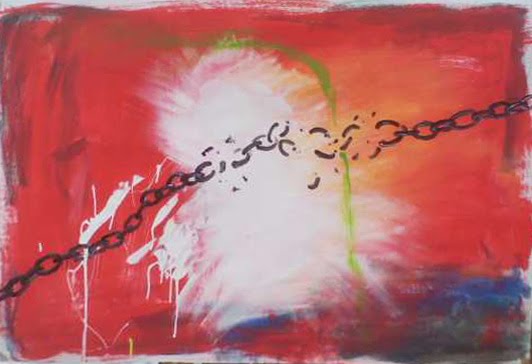
This series is regarding the paintings ‘performed’ during Faith Quest 2010. The weekend revolved around a movie theme and the speakers played with different characterizations of Jesus as found primarily in the Gospel of John. This painting was painted while Ryan Woods was speaking on “Jesus as Warrior.”
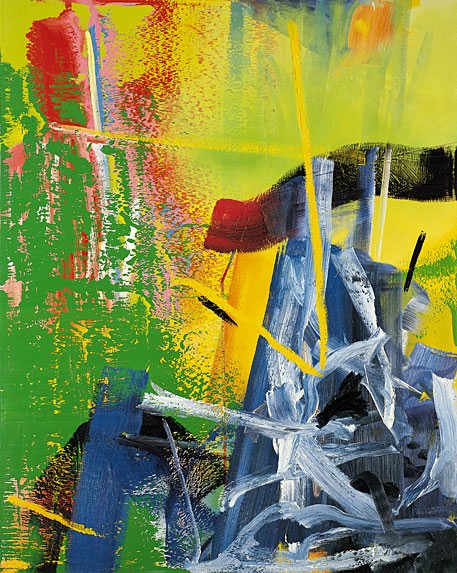
So in this case I was thinking about an artist named Gerhard Richter. This guy’s work is all over the place in the sense that he does paintings that are as accurate and ‘realistic’ as a photograph, and other paintings that are totally abstract. Most artists have a distinct style, he’s unique in that he has about a dozen distinct styles. Anyways, he has a few abstract paintings that trouble me- I don’t really like them. I don’t ‘get’ them. Which means I need to do some of those paintings and try to understand them. The green stroke is precisely that.
![]() |
| Yes- this is a painting. |
FaithQuest 2010 – "Jesus as Provider"
This series is regarding the paintings ‘performed’ during Faith Quest 2010. The weekend revolved around a movie theme and the speakers played with different characterizations of Jesus as found primarily in the Gospel of John. This painting was painted while Jeff Medders spoke on ‘Jesus as Provider.’
![]() |
| Abraham sending Hagar and Ishmael away by Rembrandt |